For venture and growth investors
You underwrite the molecule. What no one underwrites is whether the company behind it can carry that molecule to a first commercial sale — and that is where the dates actually slip.
Every company reports readiness in its own format. One framework produces scores you can set side by side.
The gaps that move a date take 12–24 months to close. Found with two years to run, it is a budget line; found with six months, it is the date.
Nobody covers a dozen companies evenly. The index says where to go first and what waiting costs.
The same 140 items score a target before the term sheet rather than after it, against the companies you already hold.
Every item is scored on whether it has an owner, a process, a budget and a system behind it, so a capability that exists on paper but has none of those reads as a gap rather than a tick.
Every company chooses its own CRO, CDMO, regulatory consultancy and quality system, and should. But each one starts from a blank page and repeats a search the last company already ran. A pre-vetted bench with portfolio terms already negotiated takes nothing away from that choice. It removes the blank page.
One readiness index per company, on the same scale, with the gate each one is working.
Illustrative only — sample portfolio.
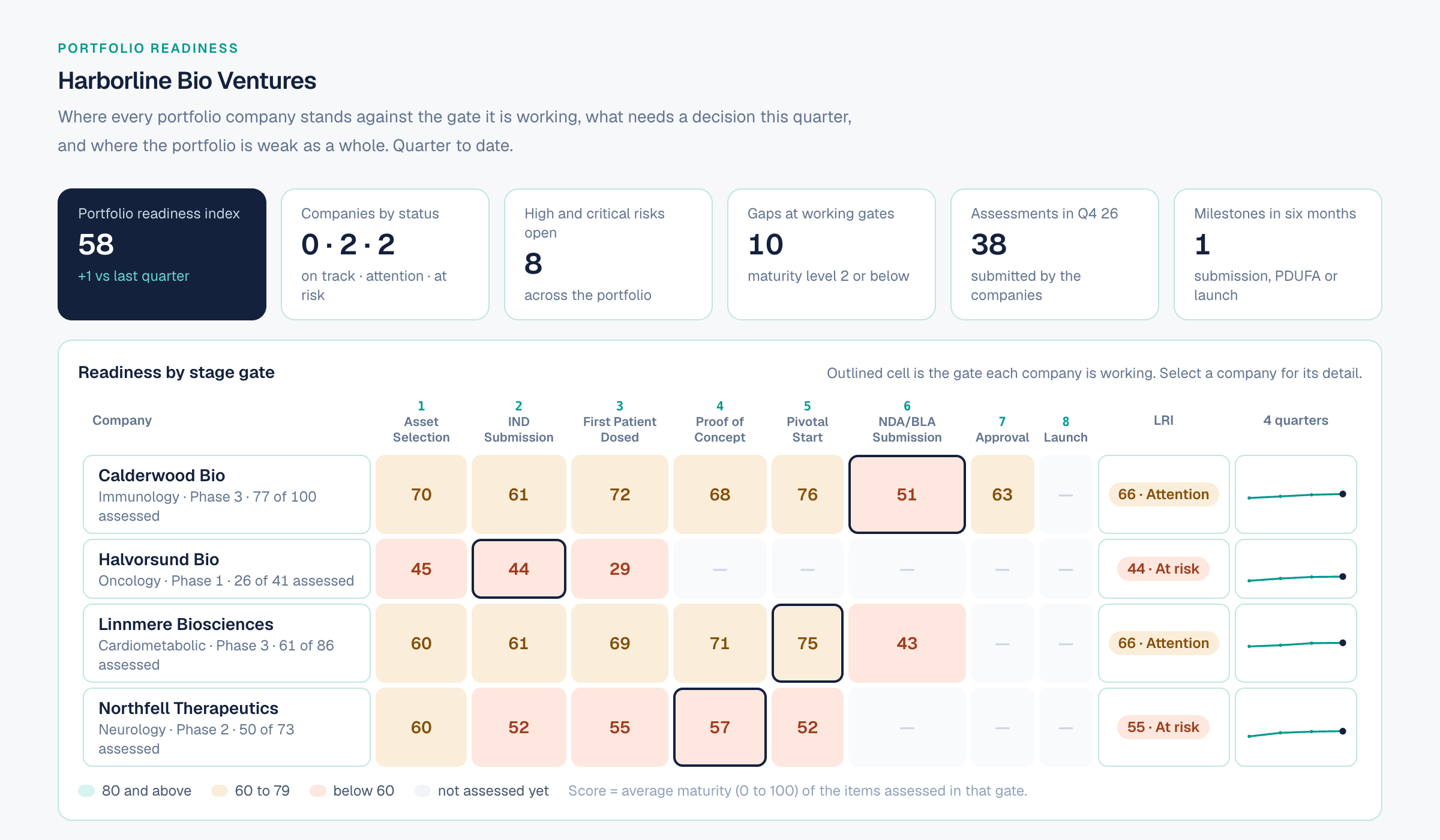
Portfolio companies keep their working detail. The fund sees enough to compare and to act.
The framework is the enterprise operating plan refined across two biopharma companies through commercial launch and a $1.2B exit.
Request an evaluation: a scored baseline across two portfolio companies, with a comparable readiness picture before your next portfolio review.